Every year, businesses across manufacturing, distribution, and F&B pour significant investment into digital transformation — new software, new systems, new workflows. And every year, a large proportion of those projects deliver far less than expected.
The technology wasn’t the problem. The sequence was.
Most implementations treat digital transformation as a one-time project: deploy the system, train the team, go live, done. But the companies that extract lasting, compounding value from their technology investments do something different. They follow a continuous loop — one that keeps improving the business long after the initial go-live.
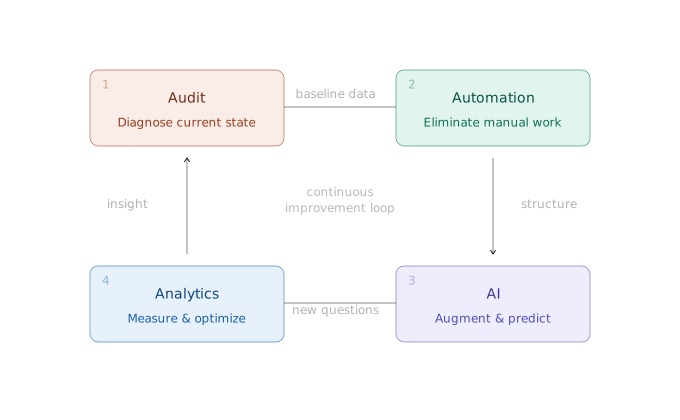
We call it the 4A Loop: Audit, Automation, AI, and Analytics.
The hidden cost of skipping steps
Before explaining the loop, it’s worth understanding why so many transformations stall.
A manufacturer invests in an ERP system but never cleans up their chart of accounts first. The system goes live with messy data, reporting is unreliable, and management loses trust in the numbers. The ERP becomes a glorified data entry tool.
A distributor deploys a new e-commerce storefront but has no analytics in place. Traffic arrives, some orders come in, but no one knows which channels are working or where customers drop off. The site runs for six months without improvement.
A food and beverage business adopts AI-powered demand forecasting but their inventory data is still entered manually, inconsistently, across three separate spreadsheets. The forecasts are wrong. The project is abandoned.
In each case, a valuable piece of technology failed — not because the technology was wrong, but because the foundation wasn’t ready for it. The 4A Loop solves this by ensuring each stage genuinely prepares the ground for the next.
The 4A Loop, explained
Stage 1: Audit — know what you’re actually working with
Every transformation begins with an honest assessment of current state. Not what the org chart says the process is, but what actually happens on the ground: where data is duplicated, where approvals get stuck, where customer information lives in someone’s personal WhatsApp, where the manual workarounds have accumulated over years.
The audit stage produces two things: a clear picture of gaps, and a baseline to measure improvement against. Without the baseline, you can never prove ROI. Without the gap analysis, you’re building on sand.
For SMEs, the most valuable audits tend to cluster around three areas: the health of financial data (particularly chart of accounts structure), the efficiency of operational workflows (where do tasks wait, and why?), and the performance of customer-facing channels (what’s driving sales, and what’s quietly leaking revenue?).
The audit isn’t just a diagnosis — it’s the document that turns vague technology decisions into specific, justified ones.
Stage 2: Automation — eliminate the work that shouldn’t require a human
Once you know where the gaps are, the next step is to close the process gaps systematically. Automation means replacing manual, repetitive, rule-based work with systems that execute consistently at any volume.
This looks different depending on the business. For a distributor, it might mean automated purchase order generation triggered by reorder points. For a manufacturer, it could be automated production scheduling based on confirmed sales orders. For an F&B operation, it might mean order routing to the right kitchen station without a phone call.
Two things happen when you automate well. First, the team’s time is freed for decisions that actually require human judgment. Second — and this is critical for the next stage — the automated processes generate clean, consistent, structured data as a byproduct. That data is the raw material for everything that follows.
Automation deployed without the audit tends to automate the wrong things, or automate chaos. Audit first, automate second.
Stage 3: AI — let the system work for you, not just record for you
With clean data flowing from automated processes, the conditions are finally right for AI to deliver real value. Not AI as a buzzword, but AI as a practical tool that answers questions your team doesn’t have time to answer manually.
What should we reorder this week, and how much? Which customers are showing early signs of churning? Which invoices are likely to be paid late? Which production batches are trending toward a quality issue before the quality check flags it?
These are questions that require pattern recognition across large volumes of historical data — exactly what AI does well, and exactly what humans do slowly and inconsistently.
The important thing to understand is that AI is not magic. It is only as good as the data it learns from. A business with two years of clean, consistent ERP data can generate forecasts that meaningfully improve purchasing decisions. A business with two years of inconsistent, manually-entered data will generate confident but wrong predictions. The automation stage is what creates the data quality that makes AI trustworthy.
Stage 4: Analytics — turn outputs into decisions
The final stage closes the loop. Analytics takes everything the automated processes and AI systems are producing and surfaces it in a form that drives decisions — dashboards, alerts, trend reports, exception flags.
But analytics does something else that’s equally important: it generates new questions. Why is the conversion rate on the mobile site lower than desktop? Why is the forecasted reorder quantity consistently higher than actual consumption in one product category? Why are approval cycle times increasing this quarter?
These new questions feed directly back into the next audit cycle. The business has learned something specific about itself that it didn’t know before, and that knowledge shapes the next round of improvements.
This is why the 4A framework is a loop, not a project. Each cycle produces better data, better processes, and better questions than the one before.
What this means in practice
For an SME beginning their transformation journey, the 4A Loop provides a clear sequence that prevents the most common and costly mistake: investing in advanced technology before the foundation is ready.
Start with an honest audit. Get your processes clean and automated before asking AI to optimize them. Measure outcomes before claiming results. Let the analytics surface the next wave of improvement.
This approach is more conservative in the short term and far more valuable over time. It is the difference between a digital transformation that delivers lasting competitive advantage and one that becomes an expensive line item with no clear return.
Working with Injani Systems
At Injani Systems, the 4A Loop is the framework behind every engagement we take on — whether that’s an ERP implementation, a workflow automation project, a digital storefront, or an AI-augmented operations system.
We build each stage with the next stage already in mind, so our clients don’t find themselves reinvesting to fix a foundation that wasn’t designed to support what comes next.
If you’d like to understand where your business sits in the loop — and what the highest-leverage next step looks like — we offer a no-cost diagnostic audit for SMEs in manufacturing, distribution, F&B, and FMCG.